
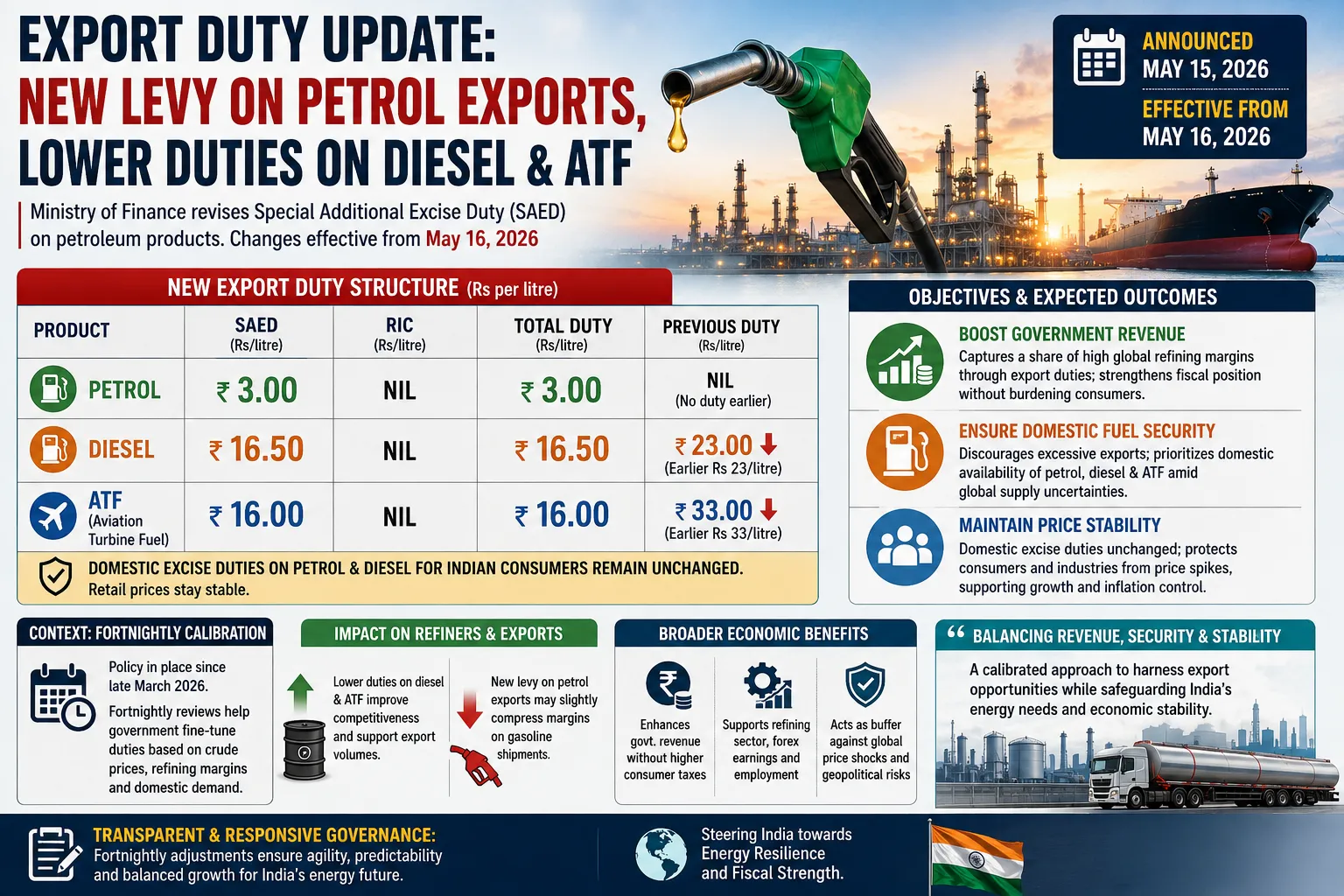
In a calibrated adjustment to export taxation, the Ministry of Finance has revised the Special Additional Excise Duty (SAED) on petroleum products, introducing a new levy on petrol exports while moderating duties on diesel and aviation turbine fuel (ATF). Announced through official gazette notifications on May 15, 2026, the changes take effect from May 16. This fortnightly review reflects the government’s ongoing efforts to manage domestic fuel availability, capture revenue from elevated global refining margins, and respond to volatile international crude oil markets influenced by geopolitical tensions in West Asia.
Under the new structure, exporters will pay Rs 3 per litre on petrol (SAED Rs 3; Road and Infrastructure Cess or RIC – Nil), Rs 16.5 per litre on diesel (SAED Rs 16.5; RIC – Nil), and Rs 16 per litre on ATF (SAED only). This represents the first imposition of duty on petrol exports since the current cycle of export levies began in late March 2026, while duties on diesel and ATF have been reduced from previous levels of Rs 23 and Rs 33 per litre, respectively. Domestic excise duties on petrol and diesel for Indian consumers remain unchanged, ensuring retail prices stay stable.
Context of the Policy: Fortnightly Calibration Amid Global Uncertainty
India, a major refiner and exporter of petroleum products, has implemented this differential taxation approach since late March 2026. The policy was introduced to disincentivize excessive exports during periods of global supply concerns, thereby prioritizing domestic availability. Export duties were hiked sharply in April to counter windfall gains for refiners when international prices offered attractive arbitrage opportunities. Subsequent fortnightly revisions allow the government to fine-tune levies based on evolving crude oil prices, refining cracks, and domestic demand.
The latest move strikes a balance. By imposing a modest duty on petrol exports while lowering rates on diesel and ATF, authorities aim to generate additional revenue without overly burdening the export sector. This is particularly relevant as Indian refiners, including major players in the public and private sectors, maintain significant export volumes to markets in Africa, Europe, and Asia. The adjustments help mop up a portion of the profits arising from strong global demand while encouraging a steady supply for the home market.
Objectives and Expected Outcomes
The primary goals of this differential taxation strategy are threefold:
-
Boosting Government Revenue: Export duties on petroleum products serve as an important non-tax revenue stream. In an environment of high global oil volatility, these levies allow the government to recover some of the fiscal impact from earlier domestic duty cuts aimed at shielding consumers. Revenue gains from exports help offset broader fiscal pressures without raising taxes on everyday Indian consumers.
-
Ensuring Domestic Fuel Security: Higher or calibrated export duties reduce the incentive for refiners to prioritize overseas sales when domestic needs are critical. This helps maintain adequate supplies of petrol, diesel, and ATF within the country, mitigating risks of shortages or price spikes amid global disruptions.
-
Maintaining Price Stability: By keeping domestic excise duties untouched, the government protects households and industries from additional cost burdens. This consumer-centric approach is vital in an economy where fuel prices influence transportation, logistics, inflation, and overall growth. The policy decouples export taxation from domestic pricing, allowing targeted fiscal measures.
Impact on Refiners and the Export Market
For Indian oil companies, the changes present a mixed picture. The introduction of a Rs 3 per litre duty on petrol exports may moderately compress margins on gasoline shipments. However, the reductions in diesel and ATF duties are expected to improve competitiveness in those segments, potentially supporting higher export volumes where global demand remains robust.
Private refiners with high export orientation may see varied effects depending on their product mix. Overall, the policy encourages efficient allocation between domestic and international markets. It also aligns with broader energy security objectives by discouraging over-exporting during periods of geopolitical risk.
Industry observers note that such fortnightly tweaks provide flexibility. They prevent extreme swings in either domestic availability or export profitability, fostering a more predictable operating environment for refiners while safeguarding national interests.
Broader Economic and Fiscal Implications
This notification comes against the backdrop of India’s commitment to fiscal prudence. By leveraging export duties, the government can enhance revenue without resorting to measures that directly affect consumers or the broader economy. In recent months, global crude price fluctuations driven by West Asia tensions have created both challenges and opportunities for oil-dependent economies.
For the Indian economy, stable domestic fuel prices support consumption, manufacturing, and agricultural activities. At the same time, a healthy refining and export sector contributes significantly to foreign exchange earnings and employment. The balanced approach helps sustain this dual benefit.
Longer-term, such policies underscore the importance of strategic taxation in the energy sector. As India transitions toward greater energy diversification and renewables, managing conventional fuel markets effectively remains crucial during the interim period. Export duties also act as a buffer against international price shocks, allowing better planning for subsidies or fiscal support where needed.
Challenges and Considerations
While the strategy is pragmatic, implementation requires careful monitoring. Excessive duties could reduce export competitiveness over time, affecting refinery utilization rates and jobs. Conversely, too lenient a regime might lead to domestic shortages if global margins prove irresistible.
The government’s fortnightly review mechanism is a strength, enabling rapid response to market changes. Transparency through gazette notifications ensures stakeholders remain informed, supporting compliance and predictability.
Stakeholders, including refiners, industry associations, and analysts, will watch closely how these rates influence trade flows, crack spreads, and overall sector profitability in the coming weeks. The policy also highlights India’s maturing approach to energy governance—balancing revenue generation, consumer protection, and market efficiency.
Looking Ahead
The Ministry of Finance’s latest revision exemplifies responsive policymaking in a complex global energy landscape. By hiking SAED selectively on petrol exports while moderating duties on diesel and ATF, and nullifying RIC across the board, the government demonstrates a nuanced understanding of market dynamics.
This differential taxation is likely to bolster government coffers, reinforce domestic fuel security, and maintain price stability for Indian consumers. As global oil markets continue to navigate uncertainties, such agile adjustments will play a key role in safeguarding economic stability.
For businesses and citizens alike, the move reinforces confidence that fiscal measures are being deployed thoughtfully—to harness opportunities from exports while protecting the foundational need for affordable and reliable energy at home. In an era of energy transitions and geopolitical volatility, policies like these help India steer a steady course toward energy resilience and fiscal strength.
pressnbcnews pressnbcnews pressnbcnews pressnbcnews pressnbcnews pressnbcnews pressnbcnews pressnbcnews pressnbcnews pressnbcnews pressnbcnews pressnbcnews pressnbcnews pressnbcnews pressnbcnews pressnbcnews pressnbcnews pressnbcnews pressnbcnews pressnbcnews pressnbcnews pressnbcnews pressnbcnews pressnbcnews pressnbcnews pressnbcnews pressnbcnews pressnbcnews pressnbcnews pressnbcnews pressnbcnews pressnbcnews pressnbcnews pressnbcnews pressnbcnews pressnbcnews pressnbcnews pressnbcnews pressnbcnews pressnbcnews pressnbcnews pressnbcnews pressnbcnews pressnbcnews pressnbcnews pressnbcnews pressnbcnews pressnbcnews pressnbcnews pressnbcnews pressnbcnews pressnbcnews pressnbcnews pressnbcnews pressnbcnews pressnbcnews pressnbcnews pressnbcnews pressnbcnews pressnbcnews pressnbcnews pressnbcnews pressnbcnews pressnbcnews pressnbcnews pressnbcnews pressnbcnews pressnbcnews pressnbcnews pressnbcnews pressnbcnews pressnbcnews pressnbcnews pressnbcnews pressnbcnews pressnbcnews pressnbcnews pressnbcnews pressnbcnews pressnbcnews pressnbcnews pressnbcnews pressnbcnews pressnbcnews pressnbcnews pressnbcnews pressnbcnews pressnbcnews pressnbcnews pressnbcnews pressnbcnews pressnbcnews pressnbcnews pressnbcnews pressnbcnews pressnbcnews pressnbcnews pressnbcnews pressnbcnews pressnbcnews pressnbcnews pressnbcnews pressnbcnews pressnbcnews pressnbcnews pressnbcnews pressnbcnews pressnbcnews pressnbcnews pressnbcnews pressnbcnews pressnbcnews pressnbcnews pressnbcnews pressnbcnews pressnbcnews pressnbcnews pressnbcnews pressnbcnews pressnbcnews pressnbcnews pressnbcnews pressnbcnews pressnbcnews pressnbcnews pressnbcnews pressnbcnews pressnbcnews pressnbcnews pressnbcnews pressnbcnews pressnbcnews pressnbcnews pressnbcnews pressnbcnews pressnbcnews pressnbcnews pressnbcnews pressnbcnews pressnbcnews pressnbcnews pressnbcnews pressnbcnews pressnbcnews pressnbcnews pressnbcnews pressnbcnews pressnbcnews pressnbcnews pressnbcnews pressnbcnews pressnbcnews pressnbcnews pressnbcnews pressnbcnews pressnbcnews pressnbcnews pressnbcnews pressnbcnews pressnbcnews pressnbcnews pressnbcnews pressnbcnews pressnbcnews pressnbcnews pressnbcnews pressnbcnews