
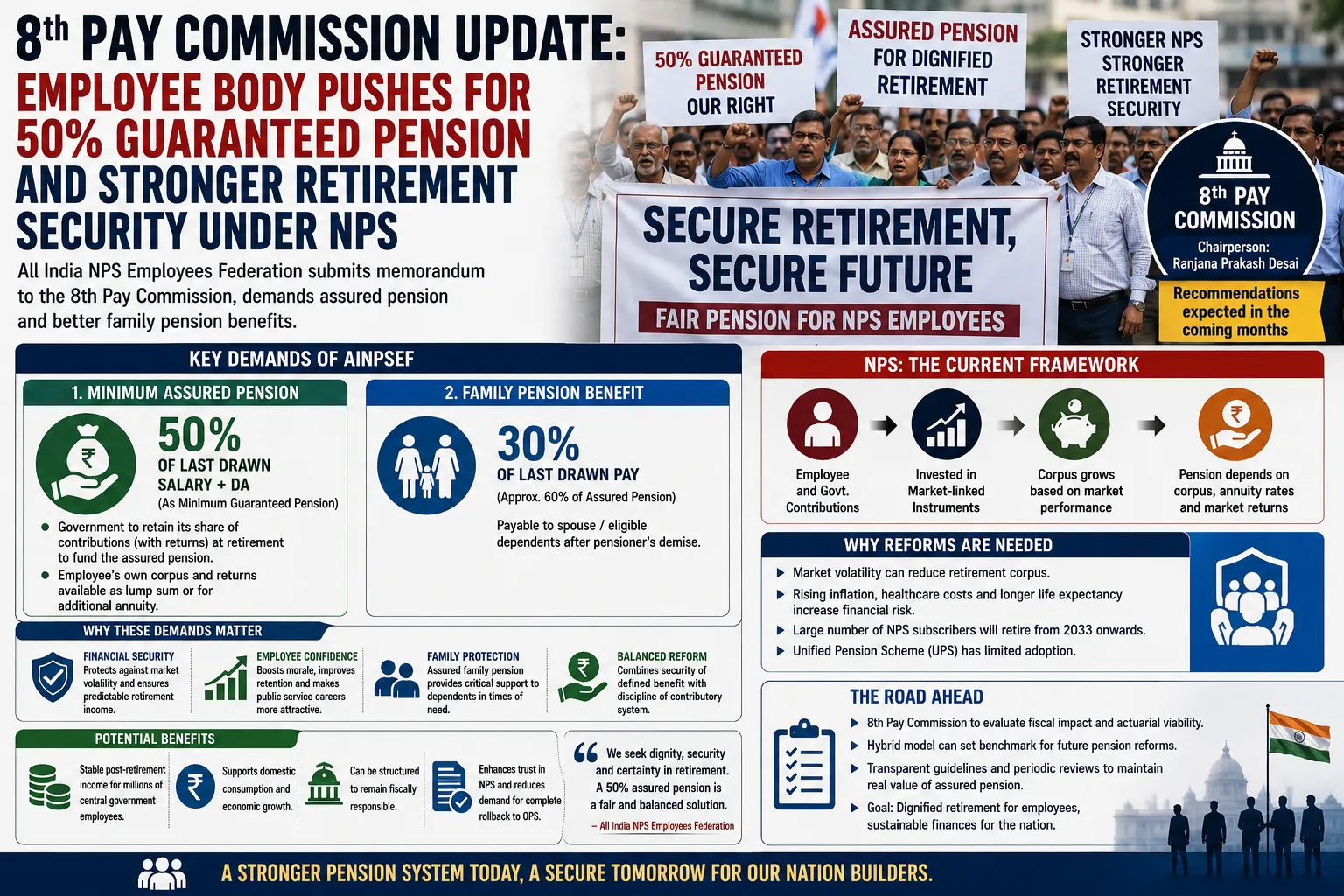
As discussions for the 8th Pay Commission gain momentum, central government employees under the National Pension System (NPS) are intensifying calls for meaningful reforms to ensure stable post-retirement income. A prominent employee federation has submitted a detailed memorandum advocating for a guaranteed pension mechanism, aiming to address growing concerns over market-linked uncertainties in the current system. At the heart of these demands is a proposal for a minimum assured pension equal to 50% of the last drawn salary plus Dearness Allowance (DA), along with enhanced family pension benefits.
The All India NPS Employees Federation (AINPSEF) has taken a proactive stance, urging the Pay Commission to introduce structural safeguards that provide predictable retirement outcomes while preserving the contributory framework of the NPS. With a significant number of NPS subscribers expected to retire starting from 2033, these demands reflect widespread anxiety about financial security in an era of volatile investment returns.
Understanding the Context: NPS and the Shift from Defined Benefits
Introduced in 2004, the National Pension System marked a fundamental shift from the Old Pension Scheme (OPS), which offered a non-contributory, defined benefit pension. Under NPS, both employees and the government contribute a percentage of salary into individual retirement accounts invested primarily in equities, government securities, and corporate bonds. The pension amount ultimately depends on market performance, annuity rates, and accumulation over the service period.
While NPS was designed to reduce long-term fiscal burden on the government and empower employees with ownership of their retirement corpus, it has exposed retirees to investment risks. Fluctuations in equity markets, interest rate changes, and longevity concerns have led many to worry that their pension might fall short of expectations, particularly for those in lower pay scales or with shorter contribution periods.
The recent introduction of the Unified Pension Scheme (UPS) aimed to offer a hybrid model with some assured elements, but its limited adoption highlights that many employees still seek stronger guarantees. Against this backdrop, AINPSEF’s proposals seek to bridge the gap between market-driven returns and the need for assured financial stability.
Core Demands: 50% Assured Pension and Family Benefits
The federation’s memorandum proposes a minimum guaranteed pension of 50% of the employee’s last drawn basic pay plus applicable Dearness Allowance. This benchmark aligns closely with the spirit of the Old Pension Scheme, providing a floor that protects against poor market performance.
To operationalize this, the proposal suggests that the government retain its share of contributions (along with accrued returns) at the time of retirement and instead provide the fixed pension amount. The employee’s own contributions and growth would remain available as a lump sum or for additional annuity purchases. This mechanism aims to deliver certainty without entirely dismantling the contributory and investment-oriented nature of NPS.
Additionally, the federation has called for a family pension equivalent to approximately 30% of the last drawn pay—or around 60% of the assured pension amount—payable to the spouse or eligible dependents after the pensioner’s demise. Such provisions would offer critical support to families facing the loss of a primary earner’s retirement income.
These demands are positioned as a balanced reform: they maintain fiscal discipline for the government while delivering the psychological and financial security employees crave in retirement planning.
Why These Demands Matter Now
Several factors make this push timely. First, as the 8th Pay Commission reviews pay structures, fitment factors, and allowances, retirement benefits form a natural extension of the broader compensation review. Employees argue that meaningful salary revisions should translate into proportional pension security.
Second, market volatility remains a persistent concern. Equity exposure in NPS, while offering growth potential during bull markets, can lead to disappointing outcomes during downturns or at inopportune withdrawal times. With inflation, rising healthcare costs, and increasing life expectancy, retirees need reliable income streams more than ever.
Third, the timing coincides with impending retirements. Employees who joined after January 1, 2004, and have contributed for nearly three decades will soon test the system’s real-world effectiveness. Their experiences will shape perceptions for future generations of government servants.
Broader employee groups have also raised related issues, including demands for optional reversion to OPS after certain years of service, higher fitment factors, and improved DA linkages. While full restoration of OPS appears fiscally challenging, hybrid solutions like assured minimum pensions could serve as a pragmatic middle ground.
Potential Benefits and Implementation Considerations
Proponents of the 50% assured pension argue that it would boost employee morale, improve retention in government service, and enhance the attractiveness of public sector careers. Predictable retirement income supports better financial planning, reduces anxiety, and allows retirees to contribute more effectively to the economy as consumers and investors.
From the government’s perspective, such a guarantee could be structured to remain actuarially sound. By utilizing its own contribution share to fund the assured portion, the net additional liability might be manageable, especially when offset against reduced future demands on social safety nets.
Challenges include accurate costing, ensuring equity across different employee cohorts, and integrating the mechanism seamlessly with existing NPS architecture. The Pay Commission would likely examine actuarial projections, long-term fiscal impact, and comparable practices in other countries that have blended defined contribution and defined benefit elements.
Experts suggest that any assured pension floor should include periodic reviews tied to inflation or DA revisions to maintain real value over time. Clear communication and transparent guidelines would also be essential to build trust among subscribers.
The Road Ahead for the 8th Pay Commission
The 8th Pay Commission, chaired by Ranjana Prakash Desai, is currently engaging with various stakeholder groups to shape recommendations expected in the coming months. Pension reform is emerging as one of the most emotive and critical areas under review.
While employee federations push for stronger guarantees, the Commission must balance these aspirations with fiscal sustainability, demographic realities, and the need to encourage personal savings. A well-designed hybrid model could set a precedent for future retirement systems in both public and private sectors.
For central government employees, these developments carry profound implications. A successful outcome could restore confidence in the NPS framework, reduce calls for complete rollback, and create a more resilient retirement ecosystem.
As deliberations continue, the focus remains on crafting policies that honor the service of government employees while safeguarding national finances. The demand for a 50% guaranteed pension represents not just a call for higher benefits but a deeper quest for dignity and security in retirement.
In conclusion, the proposals put forward by the All India NPS Employees Federation highlight the evolving expectations around public service compensation. By advocating for assured elements within a modern contributory system, they seek to harmonize the strengths of both old and new pension paradigms. The 8th Pay Commission’s response will significantly influence the future of retirement security for millions of central government employees and shape the broader discourse on pension reforms in India.
pressnbcnews pressnbcnews pressnbcnews pressnbcnews pressnbcnews pressnbcnews pressnbcnews pressnbcnews pressnbcnews pressnbcnews pressnbcnews pressnbcnews pressnbcnews pressnbcnews pressnbcnews pressnbcnews pressnbcnews pressnbcnews pressnbcnews pressnbcnews pressnbcnews pressnbcnews pressnbcnews pressnbcnews pressnbcnews pressnbcnews pressnbcnews pressnbcnews pressnbcnews pressnbcnews pressnbcnews pressnbcnews pressnbcnews pressnbcnews pressnbcnews pressnbcnews pressnbcnews pressnbcnews pressnbcnews pressnbcnews pressnbcnews pressnbcnews pressnbcnews pressnbcnews pressnbcnews pressnbcnews pressnbcnews pressnbcnews pressnbcnews pressnbcnews pressnbcnews pressnbcnews pressnbcnews pressnbcnews pressnbcnews pressnbcnews pressnbcnews pressnbcnews pressnbcnews pressnbcnews pressnbcnews pressnbcnews pressnbcnews pressnbcnews pressnbcnews pressnbcnews pressnbcnews pressnbcnews pressnbcnews pressnbcnews pressnbcnews pressnbcnews pressnbcnews pressnbcnews pressnbcnews pressnbcnews pressnbcnews pressnbcnews pressnbcnews pressnbcnews pressnbcnews pressnbcnews pressnbcnews pressnbcnews pressnbcnews pressnbcnews pressnbcnews pressnbcnews pressnbcnews pressnbcnews pressnbcnews pressnbcnews pressnbcnews pressnbcnews pressnbcnews pressnbcnews pressnbcnews pressnbcnews pressnbcnews pressnbcnews pressnbcnews pressnbcnews pressnbcnews pressnbcnews pressnbcnews pressnbcnews pressnbcnews pressnbcnews pressnbcnews pressnbcnews pressnbcnews pressnbcnews pressnbcnews pressnbcnews pressnbcnews pressnbcnews pressnbcnews pressnbcnews pressnbcnews pressnbcnews pressnbcnews pressnbcnews pressnbcnews pressnbcnews pressnbcnews pressnbcnews pressnbcnews pressnbcnews pressnbcnews pressnbcnews pressnbcnews pressnbcnews pressnbcnews pressnbcnews pressnbcnews pressnbcnews pressnbcnews pressnbcnews pressnbcnews pressnbcnews pressnbcnews pressnbcnews pressnbcnews pressnbcnews pressnbcnews pressnbcnews pressnbcnews pressnbcnews pressnbcnews pressnbcnews pressnbcnews pressnbcnews pressnbcnews pressnbcnews pressnbcnews pressnbcnews pressnbcnews pressnbcnews pressnbcnews pressnbcnews pressnbcnews pressnbcnews pressnbcnews pressnbcnews pressnbcnews pressnbcnews pressnbcnews